What if I told you I start my morning with a glass of lemon water?
Maybe you’d think:
‘Who cares?! Why does it matter what Berardi drinks first thing in the morning?’
You wouldn’t be wrong.
But if you’re a certain type of person—the kind who loves to geek out on nutrition science—it might spark your curiosity (and maybe a little FOMO).
Perhaps you’d ask:
“Why add lemon? For digestion? Liver detoxification? Antioxidant protection?”
In other words:
“Does lemon contain some sort of biochemical superpower I haven’t yet learned about? And, if so, should I be including it myself?”
If you’re another type of person—more skeptical in nature—you might be less curious and more annoyed:
“Ugh—more detoxing BS?!? Detoxing isn’t even a thing. I thought you were evidence-based!”
If you’re super up-to-date on the latest research, you might even say:
“Lemons, really? Haven’t you done your research? Don’t you know that [enter nutrient/supplement du jour] has proven to be more effective?”
So, just in case you’re wondering, here’s the real reason I drink lemon water in the morning:
I wake up thirsty. And I like the taste of lemon in my water.
(Cue anti-climactic music.)
Yep, that’s it.
That’s the big secret behind my beverage choice.
I’m not trying to support liver detoxification or digestion.
Nor am I trying to add antioxidant power or alter my body’s pH.
(I’m also not an “industry shill for Big Lemon.” Promise.)
I simply like the taste.
Now, if that answer disappoints you—or you were already halfway to the store to pick up some lemons—you might need to hear what I’m about to say.
Because I think it’s time we stop over-nutritionalizing our food.
Before we go any further, I have to admit something.
I’ve been guilty of the very thing I’m critiquing in this article. In fact, if you like, you can blame the whole problem on me.
Early in my career, I wrote A LOT, perhaps too much, about the biochemical and physiological properties of food.
I churned out article after article examining various signaling pathways in fat and muscle cells, and the specific nutrients that could alter them.
Now, I didn’t intend to start a trend of over-focusing on the scientific properties of food. To be honest, I didn’t really think much about my intention at all. (That was kinda the problem).
I was just really into biochemistry and physiology.
As a PhD candidate, publishers gave me a platform to share what I was learning, what I was experimenting with (in the lab), and what I found intriguing.
And when I co-founded Precision Nutrition, I was able to reach and influence even more people.
Along the way, readers took a cue from me.
Coaches, trainers, and fellow “nutrition nerds” fell down the rabbit hole too. They followed my interests. They started focusing on the biochemical and nutritional details of food. And, like me, they shared their interests, thoughts, and experiments with others.
It started a chain reaction.
Yet, as Precision Nutrition developed, my perspective changed.
My understanding of food broadened.
I came to believe (as I still do) that food is not merely fuel. That no single diet is universally superior. And that there are a lot more considerations to eating than “how does nutrient X affect pathway Y in my body?”.
Don’t get me wrong: Understanding the scientific properties of food is helpful—to a point.
There’s a reason why PN teaches the science of nutrition in the Precision Nutrition Level 1 Nutrition Coaching Certification: because it’s useful to understand the “why” behind nutrition recommendations before you start doling them out to clients.
But when I look around these days, I see a lot of people hyper-focused on the biochemical and physiological aspects of food.
Call it over-nutritionalizing, over-intellectualizing, or over-sciencing. Whatever name you give it, it’s characterized by an almost obsessive interest in the nutritional and physiological aspects of a given food.
And we need to tamp that down. Or, at least, balance it out.
People always ask me, “Why’d you choose THAT food / ingredient / supplement?”
Sometimes, I share pictures of what I eat on Instagram.
Either a single meal or an entire day of meals.
People are always asking me how I eat so, occasionally, I oblige by sharing my own meals or what our family is eating.
But every time I do, the same thing happens: People send a barrage of questions, most of them having to do with the physiological or health value of a particular inclusion (or exclusion). I try to answer the queries, but frankly, it’s hard to keep up.
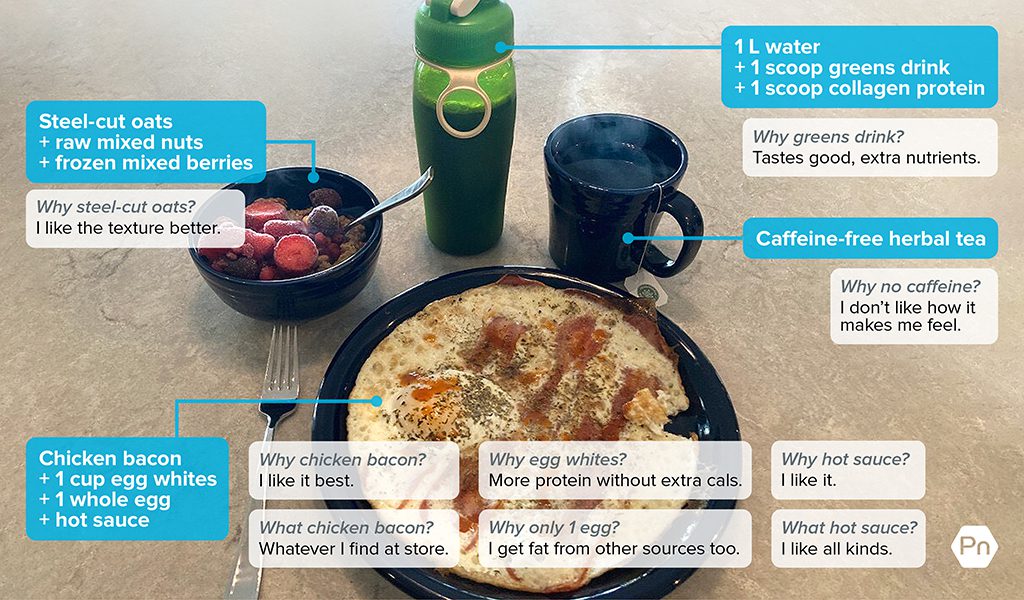
No matter how much explanation I provide, the questions keep coming. Here’s a sampling from recent posts of various meals.
- Why do you add lemon to your water?
- Why don’t you eat yams or brown rice or (my favorite starchy carb source)?
- Why don’t you eat pineapple, watermelon, or (my favorite fruit)?
- Why don’t you drink milk, eat cheese, or (my favorite dairy)?
- I see you eat sauerkraut. Why not kimchi?
- I see you use collagen protein. Why not whey?
- You take a vitamin or a protein supplement or a probiotic? Which brand? Which strain? For what benefit? But what about the research that says X or Y or Z?
You get the idea.
Hence my lemon water example from earlier. Every time I show a meal with a glass of water with lemon, people are deeply concerned with the “health value” of the lemon.
In essence, it feels like everything the nutritionist eats MUST have a scientific reason for its inclusion.
Folks seem disappointed or dissatisfied when I tell them I add it because I like the taste. Or it’s one of my favorite foods. Or it’s all I had available that day.
Similarly, if I don’t include a particular food on a given day, like brown rice or mangoes or coffee, folks get really wrapped up in whether I think the missing food is somehow “bad for you.”
Heck, everything the nutritionist doesn’t eat MUST ALSO have a scientific reason for its exclusion.
But here’s the truth:
Not every food decision I make is grounded in science.
Sometimes I eat foods because I like them. (Shocking, I know.) Or because they make me feel good. Or because our children want me to share a particular food with them.
Likewise, I often avoid other foods that I don’t like. Or that make me feel bad. (Yep, even the “healthy” ones.) Or that aren’t easily accessible to me.
Here’s an example I posted about recently.
I’ve learned, through the process of self-experimentation, that tomatoes and peppers seem to cause flare-ups in the osteoarthritis that bothers my knees.
So, most of the time, I avoid them.
Even though I like to eat them. Even though there isn’t much data to suggest that nightshades like tomatoes and peppers are problematic. I minimize them in my diet because they make me feel bad.
Now, just because I’ve stopped eating them…
Am I saying that tomatoes and peppers (or other nightshades) will affect everyone with osteoarthritis?
No.
Can I tell you for sure that it’s the biochemical properties of the tomatoes and peppers that affect me and not something else (like the placebo effect)?
No.
Am I suggesting that other people should stop eating tomatoes and peppers?
Definitely not.
They just don’t work for me.
So, what’s wrong with nerding out on nutrition?
Like I said, I’m a science guy. There’s nothing wrong with knowing your facts.
But this hyper-nutritionalizing can be problematic in a few ways:
#1: Your “research” may not be all that good.
It’s time to get real about something.
Nutrition science is complicated, and relatively early in its evolution. This means there’s a fair bit of research out there that’s open to interpretation.
(And very few absolute hard and fast rules that apply to everybody.)
As a result, it’s not hard to find research that justifies our own preferences.
Imagine this…
Suppose I enjoy a glass of lemon water in the morning. So I think to myself, “Hmm, maybe there’s a health benefit to this. Let’s find out.”
So I visit PubMed (the world’s largest index of biomedical research) and search for scientific studies that support the use of lemon water.
Or I Google something like: “health benefits of lemon water in the morning.” (Try it. You’ll get lots of results.)
Bingo. Now I can start spreading the news of the virtuous lemon water—and give myself a pat on the back for enjoying my superior morning beverage.
See the problem here?
We’re biased. This type of “research” is often a desire to justify our preferences and natural inclinations through “evidence.”
That’s a dangerous practice, one that breeds self-justification and a certain kind of “evidence blindness” to research that doesn’t support one’s preferences.
It also signals the end of curiosity, which is at the heart of scientific inquiry.
And it happens all the time, even to smart people and good thinkers.
They let their personal preferences lead their information search, instead of legitimately trying to get to the bottom of what humans do know (or can know) about a particular subject. Then, once they’ve found the research that supports what they were going to do anyway, they proselytize it as “proven” or “evidence-based.”
But “knowledge” that was gained in this fashion is, at best, incomplete.
At worst, it isn’t really knowledge at all.
#2: Food is more than its biochemical make-up. (And so are we.)
When we get hyper-focused on the science behind our food intake, we miss out on other benefits of eating, like:
- Cultural practices/traditions
- Enjoyment and pleasure
- Expressing hospitality or spending time with family and friends over a meal
- How they make us feel, physically or otherwise
Just as “health” is more than “not being sick,” food is more than just nutrients.
And, for that matter, humans are much more than our biochemical and physiological makeup.
Whether or not a food “works for us” in the context of our daily lives has to do with more than just research.
It also has to do with our goals, our preferences, our lifestyle, our cooking skills, our cultural background, our eating and living situation, our access to certain foods, our taste buds, our social determinants of health, and so much more.
Sure, there are some general nutritional basics that work for most of us, but that doesn’t mean that someone is doing it wrong if they prefer regular whole oats to steel-cut oats.
#3: It breeds judgment and the moralization of foods.
In a recent Instagram post, I mentioned that I’ve been “zero alcohol” for three years now and that I think it’s contributed, in small part, to some positive health outcomes, particularly around hormonal health.
This statement was interpreted as a win for those with a “clean eating” or “virtuous health” or “why would you put that poison in your body?” mindset.
Many folks gave me a virtual pat on the back for this choice—as in, “Exactly! Alcohol is poison!”
Meanwhile, others took it as a personal affront. Like I was attacking their decision to drink.
But for me, not drinking isn’t a moral decision. Or a tribal one. I personally abstain because avoiding alcohol seems to help with my autoimmune disease.
And, to be honest, I never enjoyed drinking that much anyway. (Alcohol makes me irritable and sleepy which, alone, is annoying and, in social settings, makes me want to go home.)
But just because I don’t drink doesn’t mean I search for all the info I can find about why alcohol is bad for everyone and then proselytize against it. I understand it serves different needs for different people. And that some of those, on balance, could be healthy… in the right context. (For examples, check out: Would I be healthier if I quit drinking?)
Bottom line: I’m not anti-alcohol, nor am I pro-alcohol; I just made a decision that felt best for me. And my point here is this:
Someone else’s food choices—whether scientifically supported or not—shouldn’t send you into a tailspin.
Nor should your personal food choices be the basis for telling others what they should or shouldn’t do, regardless of what your self-directed scan of the research tells you is “right” or “wrong.”
If you find yourself doing either, it’s time to back up and gain some perspective.
I can’t recommend a “best food” or a “best diet,” but I can recommend this.
Try to stay open-minded.
It’s up to you to find foods that you enjoy eating, and that help contribute to your goals, whatever they might be.
And if you’re a coach, it’s your job to help your clients find those foods—and those goals—for themselves.
A healthy relationship with food doesn’t require you to nitpick over every small decision or have a scientific justification for everything you choose.
In fact, once you understand the basics of how various nutrients work in the body, a healthy relationship with food might mean the exact opposite… broadening your perspective on eating beyond the “scientific benefits.”
Yes, it can take time and practice to understand what works best for you, your body, your family, and your lifestyle. And to enjoy those foods without overthinking them.
That’s the balance here.
To recognize that, at the beginning of your “healthy eating journey,” you might actually need to spend more time learning about your food to help facilitate better, more thoughtful choices.
But then, at a certain point, you might need to step back and try to integrate that new knowledge into the context of your real life. To situate it within a broader, more robust framework for making eating decisions.
Because, if you go too far here, your ideas about food can end up mired in superstition or “sciencestition.” When that happens, it’s difficult to be objective. Difficult to stay curious and open-minded. Difficult to learn anything, for yourself or for your clients.
So that’s your first experiment.
Back away from the research database. Make yourself a meal without overanalyzing it. And while you’re at it, pour yourself a glass of water. Lemon or no lemon? The choice is yours.
If you’re a coach, or you want to be…
You can help people build sustainable nutrition and lifestyle habits that will significantly improve their physical and mental health—while you make a great living doing what you love. We'll show you how.
If you’d like to learn more, consider the PN Level 1 Nutrition Coaching Certification. (You can enroll now at a big discount.)
Share